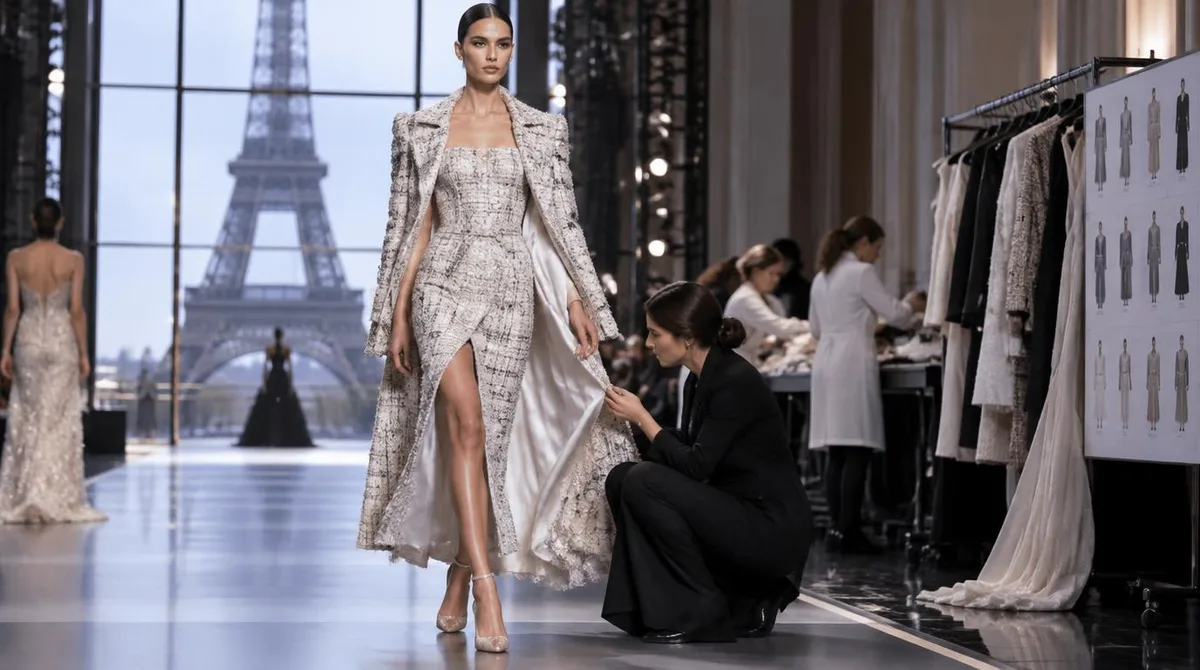
A couture show looks like twenty minutes of ease. In reality, it is the visible tip of months of invisible work: fittings that reshape a garment on a real body, dressers who rehearse fast changes until they are routine, lighting and sound cues timed to the second. The behind the scenes couture show story is really a story of choreography — most of it done before a single guest sits down.
This explainer follows that work in the order it happens, from the atelier to the final bow. It stays deliberately general: house practices differ, and the details here describe how the process typically runs rather than how any one house staged any one season. For how the Paris couture calendar itself is built, see our guide to How the Chambre Syndicale de la Haute Couture Fills the Paris Couture Calendar.
Where does a couture show actually begin?
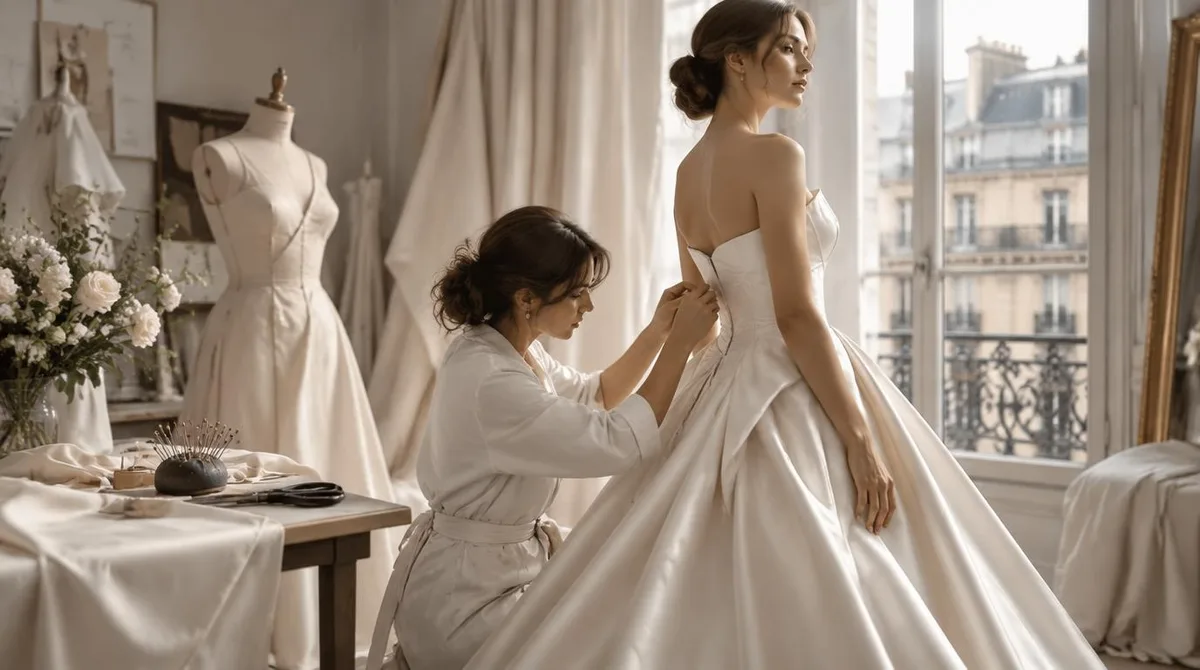
It begins in the atelier, long before a venue is booked. A couture collection is made to measure, so each garment is built around fittings on a live model or a stand that approximates one. A bodice is draped, pinned, taken apart and pinned again. The seamstresses — the petites mains who do the handwork — adjust until the cloth sits the way the designer intends.
That fitting process sets the show's real clock. A single gown can absorb weeks of hand-hours, and the schedule for the whole presentation bends around the pieces that are finished last. Production teams plan the runway around what the atelier can realistically deliver, which is why a show's running order often changes late — the clothes, not the logistics, lead.
What this means for the audience: the runway version of a look is the final draft of a long revision. The clean line you see is the edited version of many pinned, marked and re-stitched versions you never saw.
How does a look get matched to a model and a moment?
Casting comes next, and it is more than choosing faces. A fitting model — someone who works with the atelier repeatedly — helps the team understand how each garment moves on a body. Then the show casting matches bodies to garments: a structured jacket needs one posture, a fluid gown another. Walking style matters, because the garment has to survive the walk.
Once casting settles, the running order is built. Designers sequence looks the way an editor sequences a story: an opening that states the idea, a middle that develops it, a closing that lands it. The order also has a backstage logic — quick-change garments cannot sit back-to-back in the lineup, or the dressing team cannot keep pace.
That is where the two halves of the show meet. The artistic running order and the practical running order have to be the same document, and reconciling them is one of the quiet jobs of show production — the craft our piece on What a Fashion Show Production Company Actually Does for a House describes in detail.
What happens backstage on the day?
Show day backstage runs on a grid. Each look gets a station: garment steamed and hung in running order, shoes paired, accessories tagged to the look they belong with. Dressers — often one per model for fast shows — are assigned and briefed. The lineup board on the wall is the single source of truth; if the running order changes, the board changes first and everyone follows it.
Then comes the dress rehearsal. Models walk the runway in full look, at show pace, while the production team times the gaps. Dressers rehearse the changes they will actually make: which pins stay in, which zipper needs a hand, which coat gets slipped off on which side. A change that takes ninety seconds in rehearsal is a problem if the music leaves sixty.
Our article on Who Writes the Show's Soundtrack, and Why It Matters More Than You Think covers the sound half of that equation — the mix is edited to the intended pace of the walk, and the two are tuned against each other. This connects to our earlier piece, Who Writes the Show's Soundtrack, and Why It Matters More Than You Think.
Why do lighting and staging matter so much?
Lighting is the last fitting the clothes get. Fabric reads differently under different light: a satin that glows in daylight can go flat under the wrong rig, and a matte wool can lose its texture entirely. Lighting designers walk the runway with the team, checking how each fabric family behaves, and cues are programmed so the light changes with the collection's chapters, not against them.
The set does similar argumentative work. A bare runway makes the clothes the only statement; a built set places them inside an idea. Both are legitimate choices, and the set's scale is decided by what the collection needs to say — a tension our piece on The Set Is the Argument: How Show Design Started Meaning Something traces at length.
Practical steps follow from this for anyone watching closely. Notice where the light brightens and where it narrows. Notice when the soundtrack shifts. Those cues usually mark the seams of the collection — the points where the designer moved from one idea to the next.
What does the audience never see, and why does it stay hidden?
The audience sees the walk. It does not see the morning's final steaming, the safety pins that hold a hem through one pass, or the dresser's hand guiding a model out at the exact mark. That invisibility is deliberate. A couture show sells effortlessness, and effortlessness only reads when the labor disappears.
The discipline extends to timing. Shows run late for structural reasons — guests, traffic, seating — but the backstage clock is ruthless once the first look leaves. Every second of runway is budgeted against the changing time behind it, which is why a well-run show feels calm and a badly-run one feels frantic from the seats.
Our analysis: the couture show is best understood as a live edit. Months of material are cut down to a single pass, and every backstage decision — running order, casting, lighting, dressing — is an editorial choice about what the audience will have time to see. The clothes are the argument; the choreography is the grammar that lets the argument read.
What should a viewer take from all this?
Watch the seams, not just the surface. The next time you stream a couture presentation — our guide to The Best Fashion Shows to Watch From Your Sofa, and How to Stream Them Well explains how — look for three things: how the running order develops an idea, where the light and sound change together, and how the models' pace matches the garments' weight. Each is a window into the decisions made long before the doors opened. Readers following this should also see The Best Fashion Shows to Watch From Your Sofa, and How to Stream Them Well.
And remember the proportion. A look lives on the runway for seconds; it took weeks to build and a full backstage system to deliver. That ratio — months of making against minutes of showing — is the honest measure of what a couture presentation is. The glamour is real, but it is the visible fraction of a much larger machine, and the machine is the story.