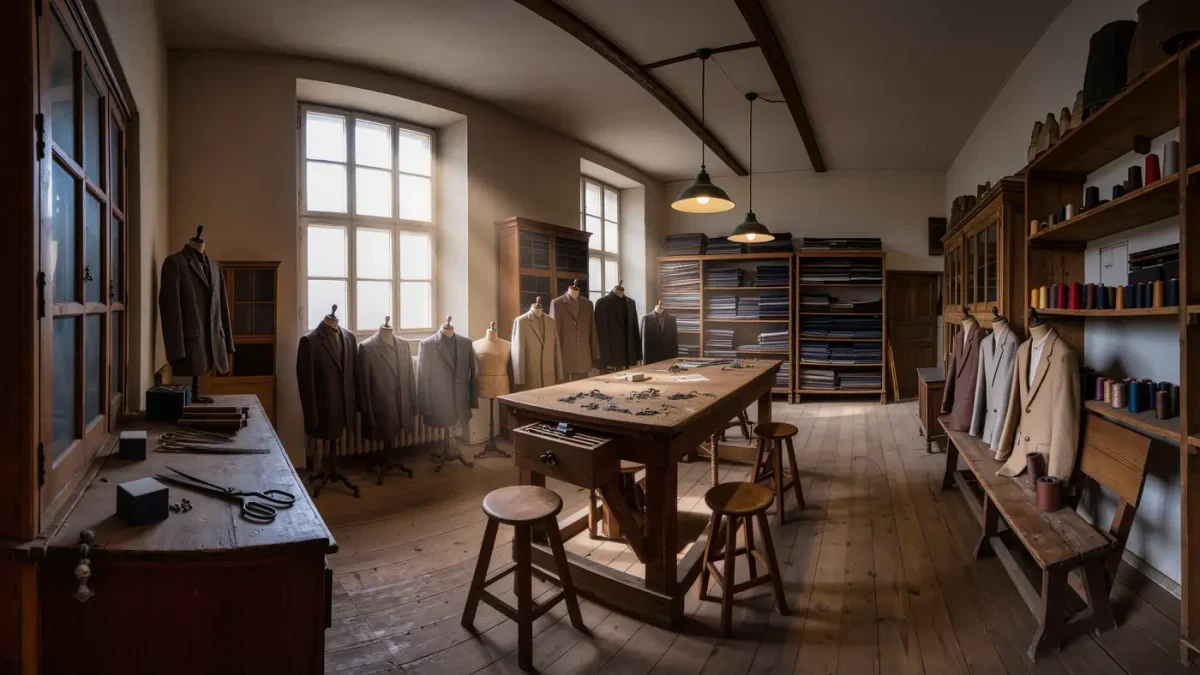
The tailored suit returns to the center of fashion roughly every decade, and the reason is structural rather than cyclical taste: tailoring is the only garment tradition where the meaning lives in the construction itself. A canvas-front jacket with a rolled lapel communicates differently from a fused, flat-fronted one to anyone who looks closely, per the construction vocabulary documented across a century of tailoring manuals and house archives. When designers want to say authority, craft or gender negotiation on a runway, the suit is the fastest sentence available.
Where does the modern silhouette come from?
From London, then Paris. The cut of the 19th-century men's coat was standardized on Savile Row and in the West End trade, and the early-20th-century refinements — the soft drape of the English cut, the sharper line of its rivals — became the technical alphabet every later designer used. Women's tailoring followed a different route: it entered the mainstream as social history, from wartime utility silhouettes to the mid-century bar-jacket line Christian Dior proposed in 1947, which re-architected the female silhouette around a tailored jacket, per the house's documented archive. Both routes left the same inheritance: a belief that a garment's line can carry an argument.
How did designers turn the suit into a statement?
By bending one element at a time. Yves Saint Laurent's Le Smoking of 1966 put a woman in a tuxedo and made the borrowed uniform the point; Giorgio Armani's 1970s and 1980s jackets dissolved the canvas and dropped the shoulder, remaking authority as ease; Rei Kawakubo and the Antwerp generation of the 1980s deconstructed the sleeve, lapel and lining to expose the construction as content. Each move was legible precisely because the audience knew the standard it deviated from — tailoring supplies the shared baseline that other fashion categories lack.
Why does the cycle keep repeating?
Because workwear keeps changing back. Each generation's dress codes loosen, casual clothing takes ground, and the tailored silhouette retreats to the runways — where it is recharged as design — before returning to daily life reinterpreted. The trade's periodic declarations that 'the suit is back' mistake the mechanism: the suit never leaves; it migrates between the street and the runway, changing hands. Recent seasons' persistence of relaxed and oversized tailoring follows the same law — the proportion changed, the construction discipline did not.
For a reader of runway seasons, the practical tool is simple: watch the shoulder. Lapel width, trouser volume and button stance all signal taste; the shoulder line signals the decade. It is the first thing a cutter drafts and the last thing an audience forgets, which is why every era's tailoring can be dated from across a room.