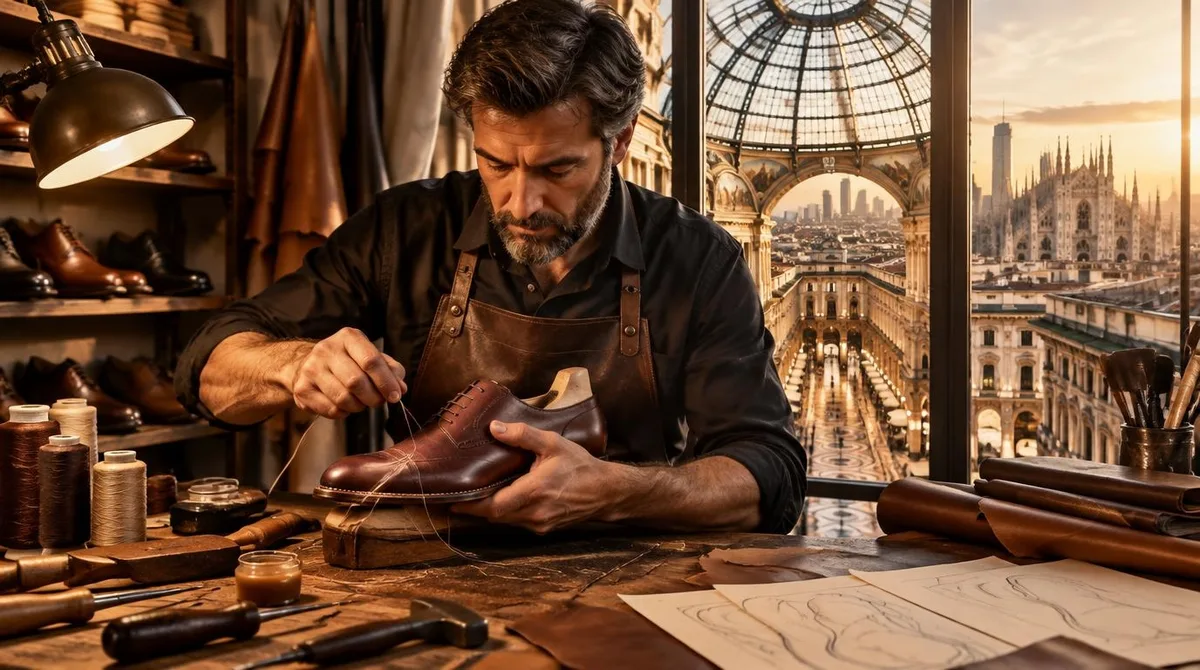
Italian luxury brands are defined less by a logo than by a supply chain: a network of family-owned mills, pattern studios and shoe workshops, mostly in the north and centre of the peninsula, that turns a designer's sketch into a finished object. What distinguishes them today is not secrecy about that chain but open celebration of it. Craft, in the current market, is the selling point.
The stakes of that argument were on display in Milan. According to Vogue, Vogue World: Milano took over the Galleria Vittorio Emanuele II to celebrate Italian craftsmanship on the world stage, timed to a moment when the publication argues that hand-forged products are becoming "luxury's most valuable currency." For the houses, the event was less a party than a positioning statement: the makers are the message.
This guide looks at what "Made in Italy" actually covers, who the makers behind the labels are, and what a buyer or a curious reader should understand about how the system works now.
What does "Made in Italy" actually mean for a luxury brand?
At its core, the phrase signals where the decisive work happened: the cutting, the construction, the finishing. In practice it covers a wide range of production, from a fully handmade garment to a factory-made object assembled in an Italian workshop. The label is a marker of origin, not a grade of handwork, and the honest houses treat it that way — the story they tell is about which atelier touched the product, not just which country stamped it. We covered a connected angle in Couture Atelier Construction — The Designer's Atelier: How Couture Workrooms Construct a Single Dress.
That distinction matters because the meaning of the phrase has shifted. Alessio Berto, a pattern-maker who started at 17 and will mark 40 years in the trade, told Vogue that the Made in Italy he knew before globalization was "not only made on Italian soil" but built from quality materials, small laboratories and serious professional know-how. His account, as the interview records it, is a useful corrective: the phrase once described an entire ecosystem of skills, and the competitive pressure on companies has compressed that ecosystem into something leaner.
For the reader, the practical takeaway is simple. When an Italian luxury brand talks about provenance, the interesting question is not "is it Italian?" but "who made it, and what did they do by hand?" The brands that can answer that question in detail are the ones treating craft as substance rather than set dressing.
Who are the makers behind the houses?
The human infrastructure is more visible than it used to be, and Vogue's profile series ahead of the Milan event is a good map of it. The people named there are not marketing faces; they hold technical authority inside the supply chain.
- Alessio Berto, founder of The Tailor Pattern Support, translates a designer's photo or drawing into a digital pattern that is industrializable and reproducible — reaching the final version, as he puts it, with as few prototypes as possible. He also teaches at two Milanese design schools, Domus Academy and NABA, explicitly to pass the knowledge on.
- Daniele Zaramella, head of research and development at the wool mill Reda, joined in 1999 and helped build the company's in-house laboratory. His team studies how a single fibre responds to cold, heat, humidity, impact and movement, and has introduced digital printing and new surface treatments.
- Ambra Lucidi, an Umbrian artisan, keeps handcraft traditions that are increasingly rare: hand-painted textiles, embroidery and hand-knitted garments that can require more than 250 hours of work.
- Francesco Baldini, technical director at the footwear brand Nomasei, is a second-generation owner of a Tuscan shoe manufacturer, Calzaturificio Everyn — the family-firm model in one sentence.
- Roberto Deambrogio heads fabric production development at Lanificio Piacenza, and Giorgio Bandoni runs the fulling and finishing department at Penta-Rif, part of the Cangioli Group, whose Lanificio Cangioli dates its name to 1859.
Read the list as a cross-section of the industry: a pattern studio, a research mill, a hand-embroidery tradition, a family shoe factory, a finishing plant. An Italian luxury brand does not own all of these skills in-house. It coordinates them, and the coordination is the craft.
What distinguishes Italian craftsmanship today?
Three things recur across the accounts, and none of them is nostalgia.
First, research inside tradition. Zaramella's framing at Reda is the clearest statement of it: "if tradition is to have a future, it must continue to evolve." A heritage wool mill running a full R&D department — testing fibres, printing digitally, questioning its own assumptions — is the modern Italian model. The past is raw material, not a ceiling.
Second, transmission. Berto moved into teaching so the next generation inherits the pattern-making knowledge; Baldini learned shoemaking from his father. The know-how lives in people, and the system only survives if each generation trains the next. This is why the artisan shortage is a structural risk for the whole sector, not a public-relations footnote.
Third, sensitivity to the individual job. Berto describes a profession where a pattern made for one brand may not work for another, where fabrics and manufacturing both change the result, and where the designer's expectation is "deeply personal." The craft is adaptive, not repetitive. That is the quiet difference between a workshop and a production line, and it is what the best Italian houses are buying when they buy Italian production.
What this means for how you read an Italian collection
Our analysis: the most useful way to judge an Italian luxury brand is to follow the citation trail from runway to workshop. A collection is the visible end of a chain of decisions — the mill that developed the cloth, the pattern-maker who solved the construction, the hands that finished the hem. When a house names its suppliers and its makers, as the Milan event encouraged, the reader can verify the story instead of trusting it.
That lens also reframes familiar names. The houses that dominate the conversation — the ones covered in our designers coverage — are best understood as orchestrators of this network. Miuccia Prada's intellectual approach to dressing, profiled in our piece on Miuccia Prada, lands on the runway only after exactly this industrial machinery has translated an idea into wearable form. The same is true of the colour-led couture revival documented in our Pierpaolo Piccioli profile: expressive vision, executed by atelier hands.
Fabric is the clearest example of the chain in action. The sourcing and testing that precedes a collection — covered in detail in our guide to how designers choose fabrics — is precisely the work Zaramella describes at Reda. And the construction end, where a pattern becomes a garment, is the territory of our piece on how a couture atelier builds a single dress. Italian luxury sits at the intersection of the two: industrial scale married to hand judgement. For related coverage, see Fabric Sourcing Designers — How Designers Choose Fabrics: The Sourcing and Testing Process Behind Collections.
Where Italian luxury goes from here
The evidence points to a sector betting its future on the visible hand. Events like Vogue World: Milano put makers on stage rather than behind it; the profile series named above makes individual artisans into public figures; the teaching appointments and second-generation family firms suggest the transmission problem is being addressed, not ignored. None of this guarantees the model's survival — the pressure Berto describes, to be streamlined and competitive, is real, and the rare skills Lucidi keeps are rare precisely because they are expensive to keep.
What the record does establish is the direction. In an era of mass manufacturing, the Italian houses have chosen differentiation through documented craft: named mills, named makers, named hours. For anyone trying to understand what an Italian luxury brand actually is, that documentation — not the logo — is the place to start reading.