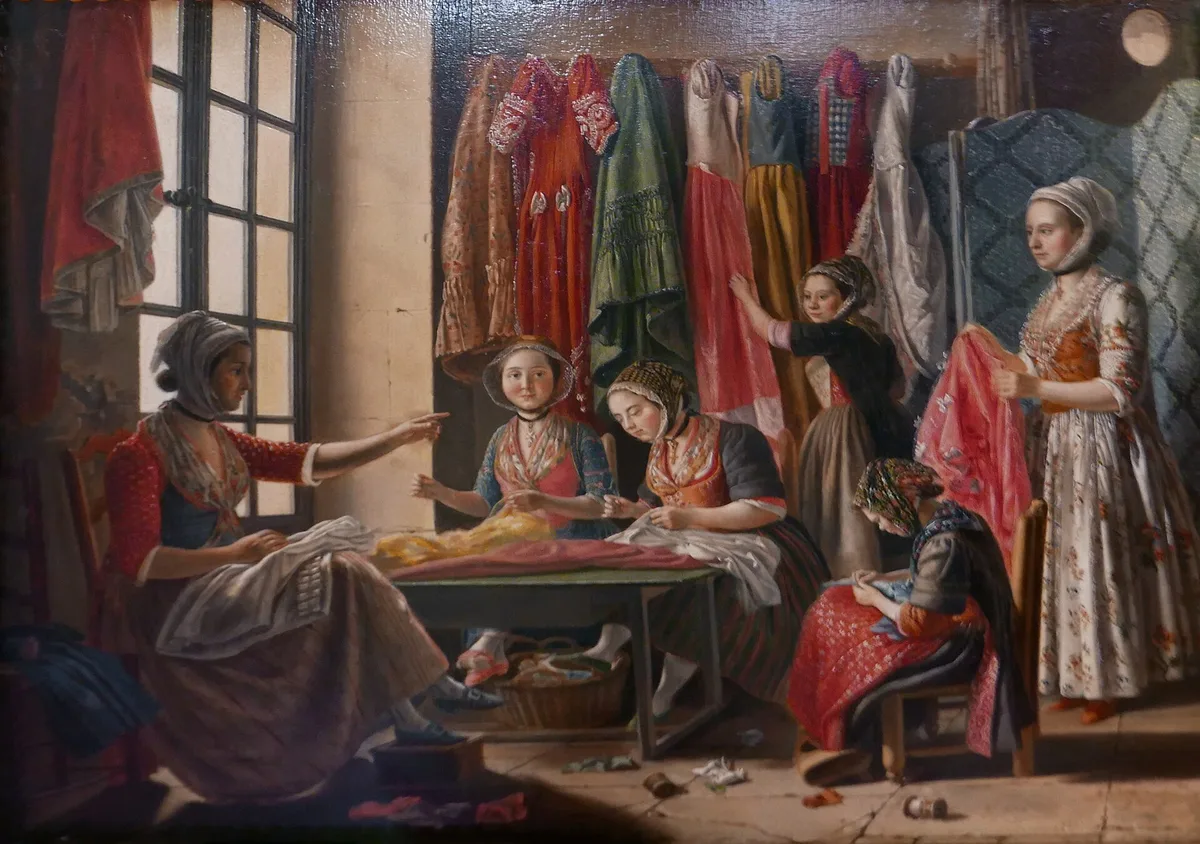
A couture dress is not sewn in a day. It is not sewn by one person, either. It is built inside an atelier: the private workshop where a principal master and a team of assistants work together on pieces released under the master's name. The workroom is where a designer's idea becomes a garment, one client and one fitting at a time.
Haute couture itself is the creation of exclusive, custom-fitted high-end fashion design. From the mid-nineteenth century, Paris grew into the centre of that trade. The industry there made outfits from high-quality, expensive, and often unusual fabric. The work was sewn with extreme attention to detail. It was finished by the most experienced sewers, often using time-consuming, hand-executed techniques.
What Makes a House Couture
The term is protected by French law. It is defined by the Paris Chamber of Commerce. The Fédération de la Haute Couture et de la Mode acts as "the regulating commission that determines which fashion houses are eligible to be true haute couture houses." Only companies on a list drawn up each year at the Ministry for Industry may use the label. In France, in other words, couture is a legal standing. It is not a marketing phrase. For related coverage, see Grace Wales Bonner Made Scholarship a Fashion Signature.
The Rules a Couture House Must Follow
The requirements are strict, per the rules of the Chambre Syndicale de la Haute Couture. A house must design made-to-order for private clients, with one or more fittings. It must keep a workshop, an atelier, in Paris. That atelier must employ at least fifteen full-time staff members. The house must also have at least twenty full-time technical people in at least one workshop. And it must present a collection of at least fifty original designs every fashion season, twice a year, in January and July, covering both day and evening garments.
Building One Dress, Fitting by Fitting
Those rules shape how a single dress gets made. The work is made-to-order for a private client. So the dress moves through one or more fittings. The garment is adjusted on the client's body between sessions. It is never finished from a standard size. The atelier's depth makes that possible. Fifteen or more full-time staff mean the hand techniques can be divided among specialists. The master's eye keeps every step pointed at the same result. The hand-executed techniques Paris became famous for are the direct product of that structure. The craft inside the fitting follows a known order. Early sessions often prove the idea in plain cloth, so the silhouette can change without waste. The fine fabric is cut only once the shape holds. Later fittings close the fit on the finished piece, where every seam can still be read and redone by hand. This connects to our earlier piece, How Designers Price a Couture Gown: Fabric, Hours and Fittings.
The People Behind the Dress
The workroom follows an old pattern. In the classic atelier system, a master works with assistants, students, and apprentices. The work is released under the master's name. Apprentices began on simple tasks and rose with their skill. Paris dressmakers, the couturières, gained their own guild privileges in 1675. That right grew out of the medieval guilds that regulated craft. Training stayed institutional too. An affiliated school, L'Ecole de la Chambre Syndicale de la Couture, was organized in 1930. Its task was to bring new designers to the couture houses.
Conclusion: Why the Atelier Model Survives
A single couture dress carries the whole system inside it. A legal definition keeps the bar high. Rules force made-to-order work and real fittings. A deep workroom divides the hand techniques among specialists. A training line has fed the houses for generations. The atelier is not nostalgia. It is the production method that makes one dress fit one body exactly, season after season.