Louis Vuitton restaged its Cruise 2026 set from the Palais des Papes in Avignon at a November 2025 show in Macao, according to a joint release from the house and Sands China. The reuse points to a wider shift already underway across fashion week: runway sets conceived, budgeted, and credited as art installations in their own right, not disposable backdrops struck the morning after.
| Designer | House | Season & City | Date Shown | Basis of Account |
|---|---|---|---|---|
| Nicolas Ghesquière | Louis Vuitton | Cruise 2026, Avignon, France (restaged Macao, China) | May 22, 2025 (Avignon); November 13, 2025 (Macao) | House materials; named coverage (WWD, PR Newswire) |
How Do Houses Turn a Runway Into an Art Installation?
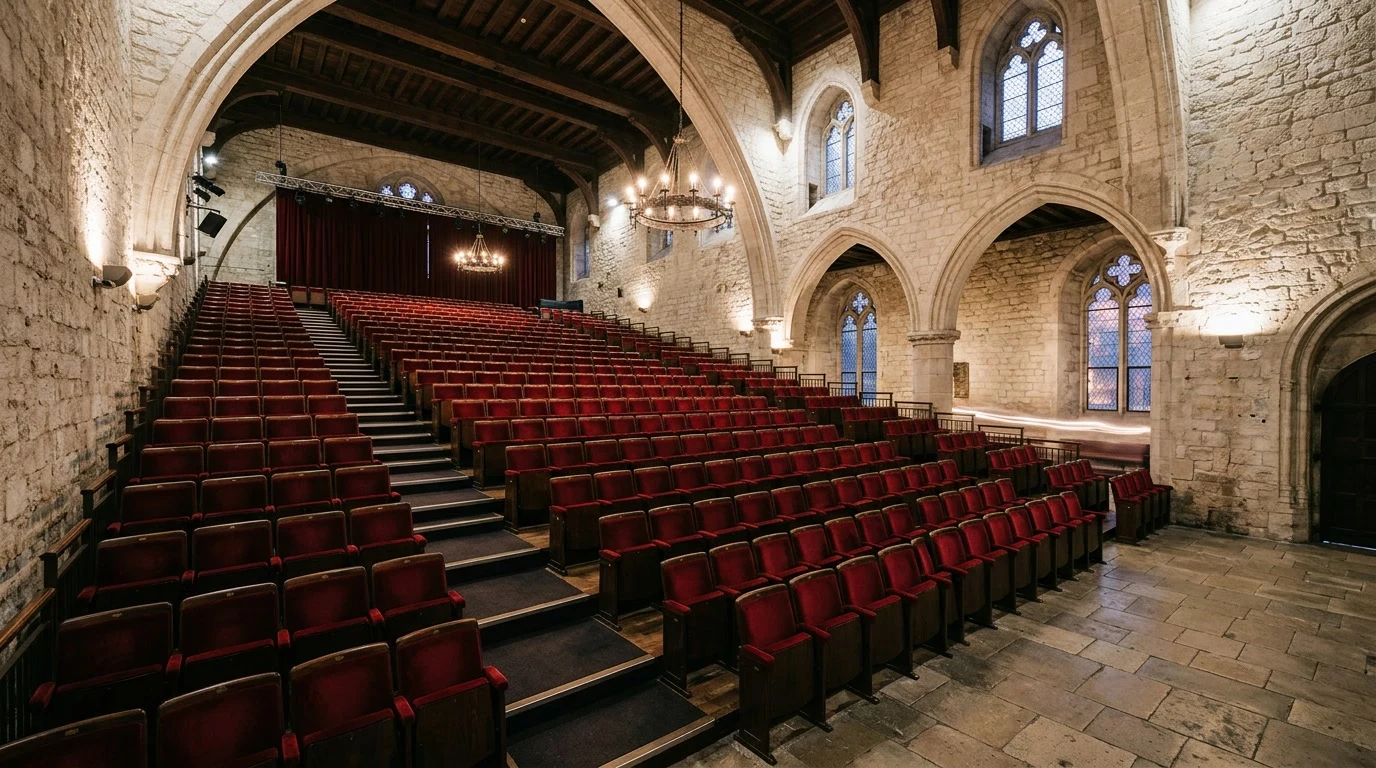
At Louis Vuitton's Avignon show, the medieval walls of the Palais des Papes stood in as the set, and the stage design came from Es Devlin, who arranged tiered red velvet theater seats left empty, inverting the venue's usual arrangement so the audience sat where performers would normally stand during Avignon's annual theater festival, as documented by WWD. Ghesquière described the concept in terms of performance rather than presentation, telling WWD he was "very interested in clothes for the stage that are so influential in fashion in general, through musicians, through actors, through dancers." Louis Vuitton's own account of the show frames the venue itself as "a theater of great history," with the medieval setting built into Ghesquière's stated aim of exploring "the performative aspect of fashion."
That approach — starting from a concept rather than a floor plan — matches how set designers describe the job more broadly. Dominic Kaffka of the design studio Focus told Fashionista that his team "always start[s] with the collection inspiration," often before seeing finished garments, given fashion week's compressed schedule; getting to know a designer's reference points in film, music, and literature matters more than a mood board. Spatial designer Kat Milne, also cited by Fashionista, said the resulting set "communicates the story of a brand very quickly and very clearly" — the installation has to read before a single look comes down the runway.
What Do Fashion Week Sets Cost, and Who Builds Them?
Budgets and timelines are tighter than the finished spectacle suggests. Broadway set designer Brett Banakis, who has worked on runway productions, told Fashionista he typically gets two to three months' notice and that fashion brands "run a fairly lean operation," with production budgets well below a theatrical show's — though he maintains meaningful design is possible at any budget level.
Scale still separates the largest houses from independent labels. Louis Vuitton has built custom oversized Parisian park benches and monogrammed bouncy houses for past shows, pieces later sold to clients rather than discarded, according to Fashionista's reporting. Independent labels more often rent from prop houses and fabric suppliers and add a small number of custom pieces — Sandy Liang's metal bow decals, Rachel Antonoff's floral dog sculptures for a dog-show-themed presentation with Susan Alexandra staffed by rescue dogs, or Jason Wu's Spring 2026 show, staged in a Brooklyn warehouse alongside artwork from the Robert Rauschenberg Foundation. Fashionista also reported that set designers increasingly plan for reuse from the start, repurposing elements for retail windows, later seasons, or pop-up shops rather than building single-use sets.
Why Are Fine Artists Now Designing Runway Sets?
Beyond stage and spatial designers, houses are increasingly commissioning working artists to build the installation itself, a trend documented in interviews with participating artists published by the art magazine Frieze. Miu Miu has commissioned site-specific installations from artist Goshka Macuga ("Salt Looks Like Sugar," 2024) and Sophia Al-Maria ("Gravity and Grace," 2023); Dior worked with the collective SAGG Napoli on a runway centerpiece that included a live archery performance; and Loewe partnered with painter Richard Hawkins on its Autumn/Winter 2024 menswear set. Other houses commissioning artist-built installations for shows include 16Arlington, Burberry, Acne Studios, and Courrèges, per the same reporting.
Artists interviewed for that coverage described the appeal in practical terms: production budgets and technical resources that outstrip what conventional art funding provides. Al-Maria said the film-shooting budget Miu Miu gave her was something she "could never have accessed" through the art world alone. Hawkins said Loewe's creative director "encouraged me to distract and overwhelm as much as I wanted," and SAGG Napoli pointed to fashion's audience reach as a way into "wider cultural conversations" beyond gallery-going crowds. Es Devlin's Avignon set for Louis Vuitton sits in the same lineage: a working artist and stage designer given a landmark building and a fashion house's production budget to stage a single evening.
What Happens to a Set After the Show Ends?
Increasingly, not much — at least not immediately. Louis Vuitton's Macao show on November 13, 2025 replicated the Avignon staging in full rather than building a new set for the occasion, according to a joint release from Sands China and the house, effectively touring the Cruise 2026 installation to a second city and audience. That impulse — treat a set as an asset rather than a one-night expense — runs through the cheaper end of the business too: Fashionista's reporting on prop reuse and Louis Vuitton's practice of selling off custom pieces both point to sets built to have a life past their runway debut, whether that means a second city, a retail window, or a buyer's living room.