London Fashion Week's spring 2027 edition closed on September 21 with Burberry, and the early verdict from the trade's round-ups is unusually warm. According to Wallpaper, "the consensus was that this week's edition has been a success." W Magazine, which ran a running list of the season's best looks, framed the week around homegrown talent before a single show had walked.
Both pieces are, in effect, favorites lists. This is a second opinion on that format: what the two accounts agree on, where their agreement is doing less work than it appears, and which parts of the week a list of favorites structurally cannot hold. The evidence here comes from those two published accounts alone, and both deserve a closer read than a scroll.
The honest summary is this: the week's headline facts are strong, the garment-level detail is thinnest exactly where the praise is warmest, and a reader who wants to judge the season should weight the concrete descriptions over the consensus line. Presentation, staging, and venue choices carried real weight this season, which is where fashion's overlap with art practice showed itself most clearly.
What do the two round-ups actually agree on?
On the facts, the accounts line up cleanly. The week's biggest return was McQueen, which showed in London for the first time after 25 years of showing in Paris, with creative director Seán McGirr bringing the house back to its roots. According to W Magazine, the return was a coup for the British Fashion Council and its chief executive, Laura Weir, who has sought the move since taking the job last April.
Mulberry also returned to the calendar after a six-year hiatus, now led by Christopher Kane, showing for the first time since his eponymous label closed in 2023. Wallpaper called his "modern, streamlined" vision for the heritage house one of the week's highlights, and quoted him directly: "For me, heritage is a foundation, not a limitation. I want to write my own codes." The week closed with Daniel Lee's Burberry, a collection of "lived-in imperfection" made with the 85-year-old textile designer Celia Birtwell, whose prints defined the 1960s and 1970s. "Nothing is overly pressed or pristine," Lee said. "There's an intentional imperfection: the idea of owning a piece, living in it."
Is the 'success' verdict earned, or circular?
Here the skeptical reading starts. Wallpaper's consensus-of-success claim rests largely on the schedule itself: Weir, now in her third season, promised to restore London's reputation as a hub of creativity, and the returns of McQueen and Mulberry are offered as proof. But a schedule built around homecomings is a schedule, not a verdict. The houses returned for their own reasons, and the claim that their presence confirms momentum is close to restating the promise as the result.
That said, the skepticism only goes so far. W's preview, published before the shows, already flagged the depth of the calendar: Simone Rocha, Erdem, Tolu Coker, Richard Quinn, and Emilia Wickstead as London regulars, plus a Newgen class of Pauline Dujancourt, Petra Fagerström, Charlie Constantinou, E.W.USIE, Liza Keane, and Oscar Ouyang. The city also lost Conner Ives to New York this year, a fact W noted plainly. A fair reading holds both: the calendar is genuinely full, and "success" remains a claim about confidence rather than a measured outcome.
Where does a favorites list fall short?
A list of favorites rewards names a reader already knows. McQueen, Burberry, and Kane at Mulberry will anchor nearly every round-up, and there is nothing wrong with that. But the most concrete, most interesting descriptions in the retrieved coverage sit further down the calendar, and a skim of the headlines would miss them.
Consider Oscar Ouyang, the Central Saint Martins graduate born in Beijing, who showed on the sunlit upper floor of Rochelle, a former school in Shoreditch. Wallpaper's account is specific: a dinner jacket with its arms cut away and its lining on show, waistcoats flapping open, satin safari jackets nipped at the waist with a tassel fastening, knitwear still central to a designer who began his career in the medium. He described the collection as being about the "uncertain interval between adolescence and adulthood." That is a garment-level record, not a verdict.
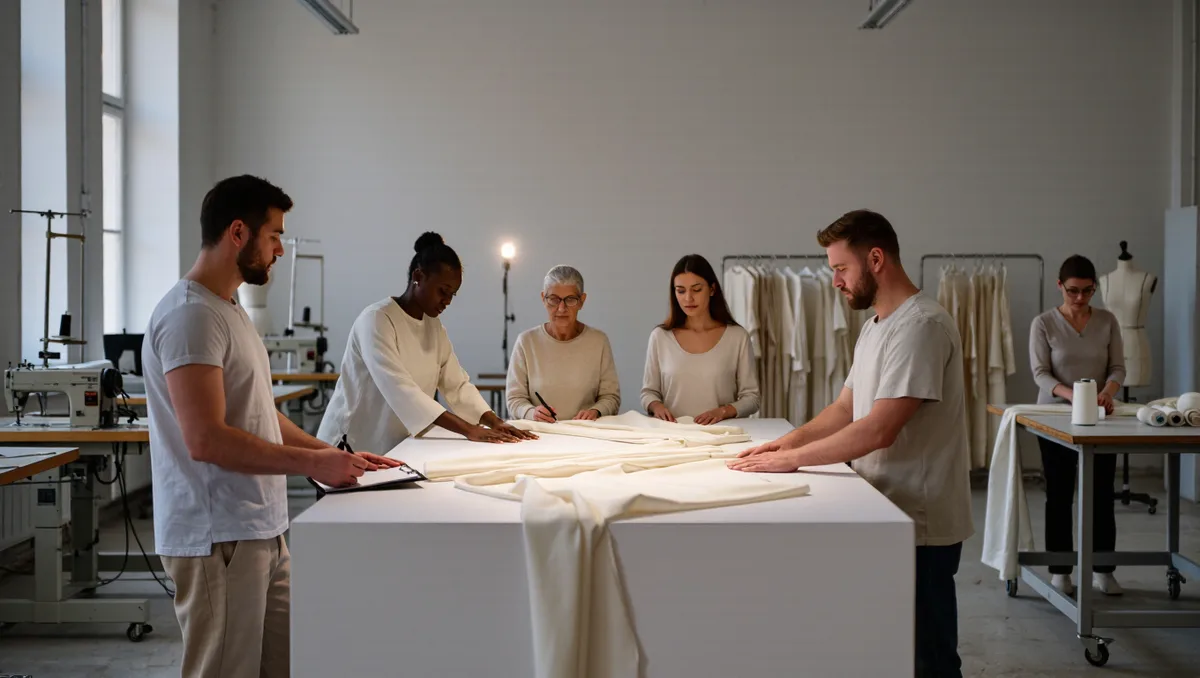
Or A Letter, the debut runway show from Matt Empringham and Freddy Coomes, alumni of JW Anderson and Loewe respectively, shown at the Rose Easton Gallery in natural light against bright white walls. Wallpaper noted the staging sharpened the view of the garments, which were built from "a pile of British clothes" and hung away from the body with a paper doll quality. The most intriguing pieces were PVC dresses with a degradé effect, fabric at the front and sheer at the back. Per the Dal Chodha-written press notes: "A new kind of eccentricity lurks in plainness."
Venue choices did narrative work all week. Fashion East, Lulu Kennedy's incubator, showed at Manor Place, a community space made with Palace and Nike, with returning designers Jacek Gleba and Goyagoma by Traiceline Pratt alongside newcomer Mé Mé, a Central Saint Martins MA graduate who has worked at Alexander McQueen and Maison Margiela. How a room shapes what an audience sees is its own discipline, one this desk has traced before in the set-design economy behind major houses' staging budgets. For related coverage, see Inside Fashion Week's Set-Design Economy, From Louis Vuitton to Miu Miu.
What should a reader take from the season's coverage?
Two things, held together. First, the headline facts are real: a McQueen homecoming after 25 years in Paris, Kane's first show since 2023, a Burberry closer built on deliberate imperfection, and a Newgen and Fashion East pipeline that keeps producing designers with distinct, describable ideas. Second, the superlatives attached to the big houses rest on thinner published evidence than the plain descriptions attached to the small ones. The McQueen homecoming carries its own theatrical history, from the house's runway performances of the past to the museum afterlife of its garments. This connects to our earlier piece, How Fashion Houses Commission Site-Specific Art Installations for Runway Shows.
What the evidence does not establish is anything commercial: sales, orders, press value, or whether the returns hold for a second season. Wallpaper's consensus and W's enthusiasm are both impressions from the runway, published within days of the close. A measured reader accepts the week as a strong one on the record shown, and waits on the rest.