The Paris couture calendar is not open entry. The Fédération de la Haute Couture et de la Mode assembles each Haute Couture Week from three tiers — members of the Chambre Syndicale de la Haute Couture, correspondent members and guest members selected by that body, per the federation’s events page — and only the members are guaranteed a slot.
Who decides which houses show couture in Paris?
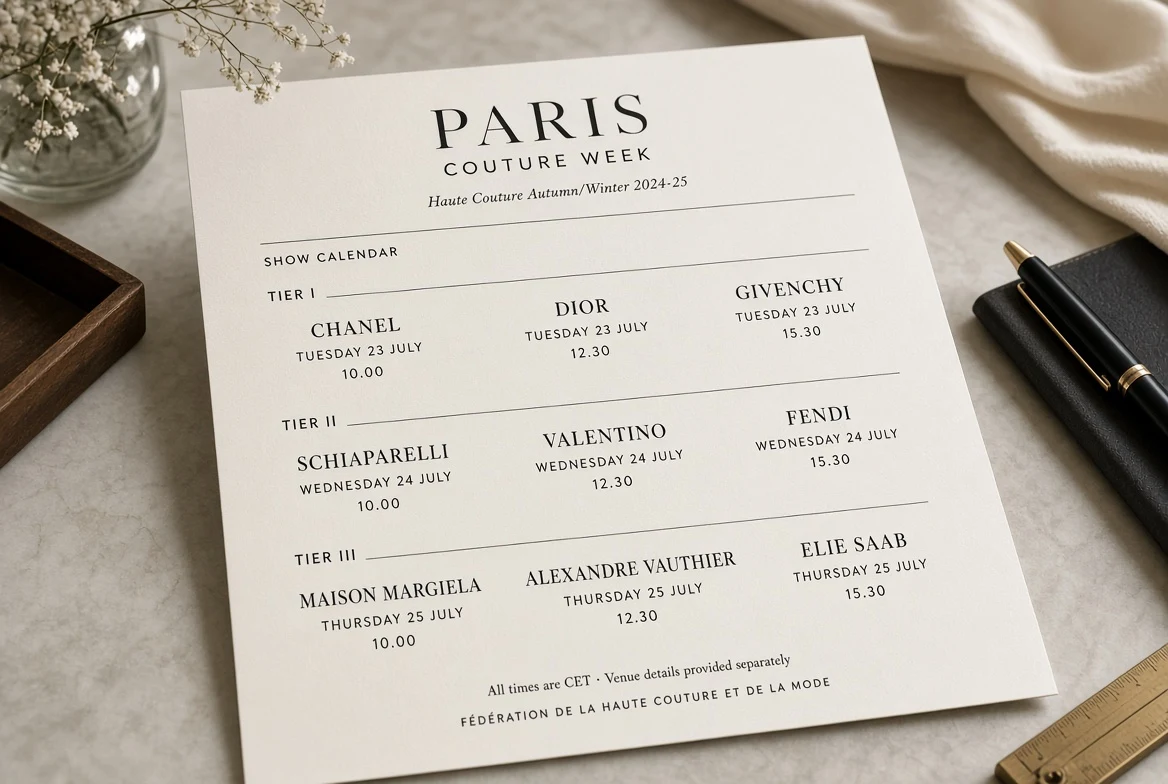
The Chambre Syndicale de la Haute Couture, operating within the Fédération de la Haute Couture et de la Mode, selects the correspondent and guest houses and publishes the resulting schedule. The federation states that the Official Calendar of Haute Couture Week "brings together the Members of the Chambre Syndicale de la Haute Couture, corresponding Members and Guest Members selected by the Chambre Syndicale." Per the federation's events page, Haute Couture Week "takes place twice a year (spring/summer in January and fall/winter in July)" — two fixed windows, both in Paris, both set by the same body.
That twice-yearly rhythm is the spine of the couture season. Spring/summer collections are shown in January; fall/winter collections are shown the previous July, which is why the fall/winter 2026-2027 season was staged in the middle of 2026 rather than at the end of it. The federation's provisional calendar for that season dated the week from Monday, July 6 to Thursday, July 9, 2026.
The federation frames its own remit in terms of the city rather than any single house: it exists, in its words, to help "consolidate Paris in its role as world fashion capital," coordinating both Paris Fashion Week and Haute Couture Week. The calendar is the instrument through which that coordination happens. A house is either on it or it is showing outside it.
What does the term haute couture legally require?
In France, haute couture is a protected designation rather than a marketing adjective, and the distinction predates the modern federation. A Library of Congress law blog analysis published in July 2025 traces the enforceable criteria to a ministerial order of April 6, 1945, following a government designation decision that January.
According to that analysis, houses granted the designation must design and create custom garments made to a client's exact measurements, entirely in-house, with multiple fittings. They must present two collections a year in Paris — January and July — with at least 25 original looks in each, and the work must be original rather than sourced from outside designers. Approval, the analysis notes, comes from a special commission under the Ministry of Industry and is reviewed annually.
Two consequences follow for the calendar. The legal designation and the calendar slot are separate things: a house can appear on the Official Calendar as a guest without holding the appellation. And the annual review means the roster of houses entitled to the term is not permanent, which is part of why the schedule reshuffles from season to season.
How do member, correspondent and guest status differ?
Members of the Chambre Syndicale de la Haute Couture are the fixed element. As Fashionista reported on January 8, 2026, only official members — the publication names Chanel and Dior among them — are guaranteed a place on the schedule; correspondent and guest houses are selected by the committee season by season.
Correspondent members are foreign houses admitted to the calendar; guest houses are invited for a given season. The federation is explicit that the third tier carries its own screening: "The status of 'Guest' is subject to a specific examination procedure by the Haute Couture Committee." Nothing about that status carries over automatically to the next January or July.
The churn is visible in the record. For the spring 2026 season, staged January 26-29, 2026, Fashionista noted Phan Huy and Celia Kritharioti as new guest designers, and recorded Jean Paul Gaultier as absent from that couture schedule. Six months later, the federation's own provisional calendar for fall/winter 2026-2027 listed Jean Paul Gaultier on Thursday, July 9 — a reminder that an absence from one couture calendar is not a departure from the format.
What does a house have to submit, and when?
Admission runs on deadlines, not on relationships stated after the fact. The federation set the submission cutoff for the Official Calendar of Haute Couture Week fall-winter 2026/2027 at no later than Wednesday, April 1, 2026 — roughly three months before the July 6 opening.
For the ready-to-wear side, the federation publishes firmer written thresholds. Applicants to the Paris Fashion Week calendar must have a legal structure, must have at least one commercialised collection, and must want inclusion in the Official Calendar on a long-term basis. The federation also rules out certain product categories outright: "Collections consisting solely of accessories, swimwear, lingerie and/or bridal wear are not eligible for admission to the Official Calendars."
Those ready-to-wear criteria are worth reading alongside the couture procedure rather than as a substitute for it. They establish the federation's general posture — a candidate is assessed as a business with a track record, not on a single collection — while the couture committee's guest examination remains the separate gate for Haute Couture Week.
Why the tier system shapes what a couture season looks like
The three-tier structure explains the composition of any given couture week better than any account of individual shows does. A guaranteed core of member houses anchors the week; the correspondent and guest tiers supply the volume and most of the season-to-season variation. The provisional fall/winter 2026-2027 calendar illustrates the mix, listing Schiaparelli, Christian Dior, Chanel, Balenciaga, Giorgio Armani Privé, Elie Saab, Rahul Mishra, Robert Wun and Ashi Studio among the houses scheduled across the four days.
That is also why the couture calendar functions as a proving ground. A house that shows once as a guest has cleared a committee examination, not bought a slot, and the following season's calendar records whether it cleared it again. Read that way, the schedule is a document about standing, not just about scheduling.
The system's discipline is administrative rather than aesthetic, and it is the more durable for it. The names change; the two windows, the committee, and the 1945 criteria behind the term itself do not.