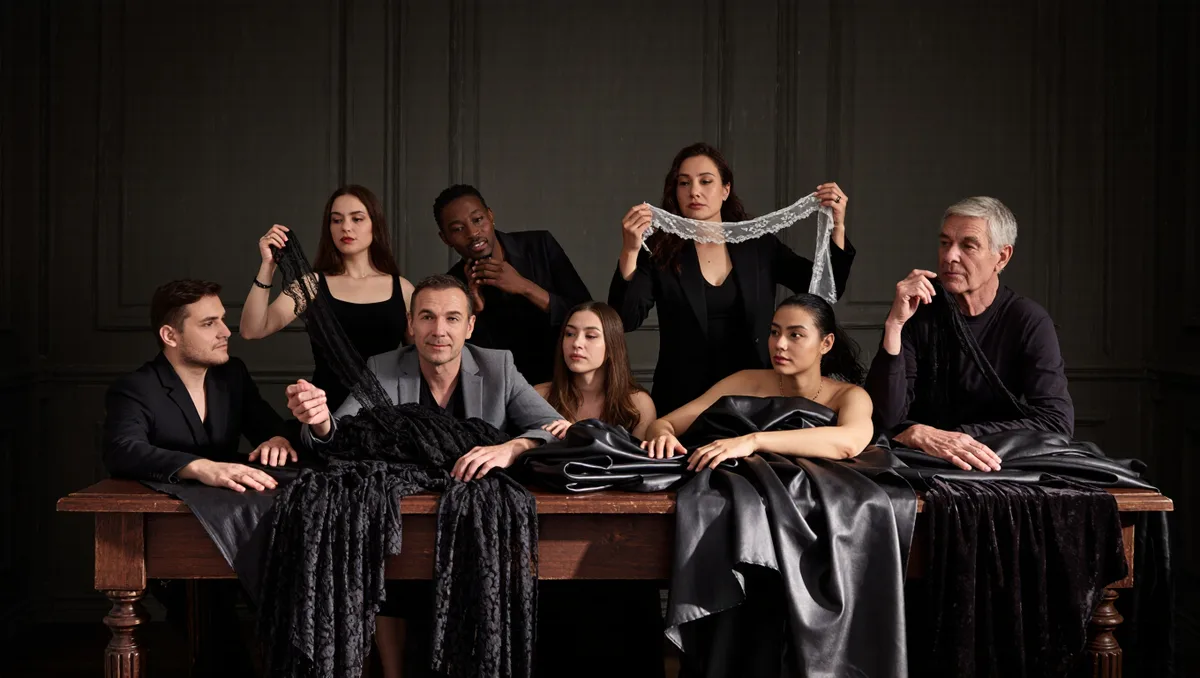
A luxury brand is a house whose name carries the value, not the object alone. Two coats cut from similar wool can sit side by side on a rail. The one with a house name inside the collar asks more, and gets it, because the name stands for a record: decades of cut, fabric and finish that a buyer can trust without touching the cloth.
That record is what separates a luxury house from an expensive label. Price is easy to raise; a reputation for craft is not. This piece looks at what the word actually means, how economists define a luxury good, and which pillars — heritage, craftsmanship, restraint, and now sustainability — let a house earn its name and keep it.
What does the word "luxury" actually mean?
Start with the dictionary. Merriam-Webster defines luxury as, first, "a condition of abundance or great ease and comfort," and, second, "something adding to pleasure or comfort but not absolutely necessary." The word entered English in the 14th century, and its roots are older and harsher than the shopping bag suggests.
According to Wikipedia's entry on luxury goods, the term traces to the Latin "luxuria" — excess, extravagant living, profusion — and carried negative connotations for most of its history. Only as it moved into English did it lose that taint: by the 1630s it meant "habit of indulgence in what is choice or costly," and by 1780, "something choice or comfortable beyond life's necessities." The Oxford English Dictionary gloss it quotes is still the cleanest: "a thing desirable but not indispensable."
That definition — desirable, not indispensable — is the hinge. A luxury brand sells the desirable, and its entire job is making the desire hold up after the purchase.
What makes a good a luxury good in economic terms?
Economics gives the sharpest test. A luxury good is one where demand rises faster than income. Wikipedia's entry puts it plainly: if income rises 1 percent and demand for a product rises 2 percent, that product is a luxury good. Necessity goods behave the opposite way — demand holds steady, or barely moves, when money gets tight.
The same entry notes why people buy them: for "intrinsic quality and to signal their wealth and confirm social status." Both halves matter. The garment has to be genuinely well made, and it has to be legible — the name, the cut, the codes recognizable to others. A house that delivers only one half struggles. Quality without recognition is a well-kept secret. Recognition without quality is a discount waiting to happen. Readers following this should also see Demna Opened His Gucci Era Without a Runway — and Made the Wait the Statement.
There is a corollary that shapes every house's decision-making: because demand rises faster than income on the way up, it falls faster on the way down. Luxury is exposed in bad economies in a way groceries never are. That is why the strongest houses treat the brand name as the asset to protect, even when protecting it means leaving sales on the table.
Why does heritage matter so much to a house?
Heritage is shorthand for a verifiable record: what the house made, for whom, and how long it has kept its standards. It cannot be bought quickly. A founder's name, a founding craft — a saddle-maker's stitch, a couture atelier, a watchmaker's movement — and a continuous archive give a buyer something no marketing campaign can manufacture: evidence.
This is also why creative-director transitions are the riskiest moments in the life of a house. The new designer must renew the work without breaking the record the name rests on. Our earlier coverage of how creative direction transitions balance heritage and innovation shows the pattern across recent appointments: the archive is quoted, not discarded. A house that hands its codes to a designer who ignores them risks the one asset it cannot reprint. We covered a connected angle in At the Houses, a New Rulebook: How Creative Direction Transitions Balance Heritage and Innovation.
What role does craftsmanship actually play?
Craftsmanship is the part of luxury a buyer can verify with their hands. It shows in concrete garment terms: the grain of a leather matched across a bag's panels, a jacket's canvas chest that holds shape after years of wear, a hem finished by hand where a machine would show. These details cost time, and time is the one input a fast-production system cannot compress.
That cost is the point. Scarcity of skilled labor, and the hours embedded in a finished piece, are what make the object hard to copy at any price. When a house claims craft, the claim is testable — unpick a seam, look at the lining, wear the coat for a season. The houses that last are the ones whose claims survive that test.
How does marketing build — or spend — a luxury name?
Luxury marketing works by subtraction more than addition. The tools are restraint and repetition: few products, controlled distribution, little discounting, and a steady visual language repeated for decades. Every markdown teaches the customer to wait; every dilution of the name — a cheap license, an over-extended logo — spends capital built over generations.
The industry now also markets its values. When the World Luxury Chamber of Commerce unveiled its TOP 100 Best Luxury Brands of the World on October 8, 2025 — the first World Luxury Day — it framed the honorees as defining luxury "not merely a reflection of price or exclusivity, but a celebration of heritage, artistry, experience, and purpose," naming excellence, craftsmanship, innovation and sustainability as the modern criteria. The list spans fashion and beauty alongside hotels, watches, cars and spirits — names like Hermès, Chanel, Cartier and Bottega Veneta sit next to resorts and private banks — which is a reminder that the mechanics described here are sector-wide, not fashion's alone.
What this means for the buyer
Our analysis: judge a luxury brand the way the economics does — on what the name guarantees, not what it promises. Three checks travel well.
- Trace the record. How long has the house made this category, and is the craft claim specific enough to verify — a named technique, a named atelier, a construction detail you can inspect?
- Watch the discipline. A house that discounts heavily and licenses its name widely is spending its heritage. Scarcity, kept honestly, is part of the product.
- Weigh longevity against price. The dictionary's "desirable but not indispensable" cuts both ways. A luxury purchase earns its place when the desirability lasts — a coat worn for a decade beats a logo bought for a season.
The word has traveled a long way from "luxuria," and it has blurred as luxury reached more buyers — Wikipedia notes that categories like "accessible luxury" have made the term harder to define, not easier. But the underlying test has not moved. A house earns its name when the object, the record and the restraint all point the same way. When any one of the three slips, the price is the first thing the customer stops believing.
For more on how the industry's news, shows and designers shape what houses do next, follow our Fashion News desk, where we cover the runway, the designers, and the business decisions behind both.