Hussein Chalayan's graduate collection at Central Saint Martins in 1993 — garments buried in a friend's garden with iron filings and dug up for the show, 'Tangent Flows' — set the terms of a three-decade career: fashion treated as applied research, with the garment as one output among furniture, film and performance, per the documented record of the collection and retrospectives since. The London-based, Cyprus-born designer has shown on the capital's official calendar since 1995, twice named British Designer of the Year (1999 and 2000, per the award's records), and his runway landmarks — the 'Remote Control' dresses of 2000 that transformed from furniture, the laser-lit 'Airborne' gown of 2007 built with Swarovski crystal and thousands of LEDs — are the trade's standard citations for fashion-as-idea.
What is Chalayan's actual subject?
Migration, identity and technology — the forces that move people and things. His best-known collections argue themes rather than seasons: 'Past Forward' (1996) on religious dress codes, 'Afterwords' (2000) on displacement, staging a living room whose furniture covers became a survivor's wardrobe, per documented show records. The method is research-first: each collection reads like a thesis defended in fabric, with the sources — anthropology, architecture, political history — visible in the show's titles and staging. That is why museums adopted the work early: the garments carry arguments complete enough to exhibit without the season's context.
How literal is the technology?
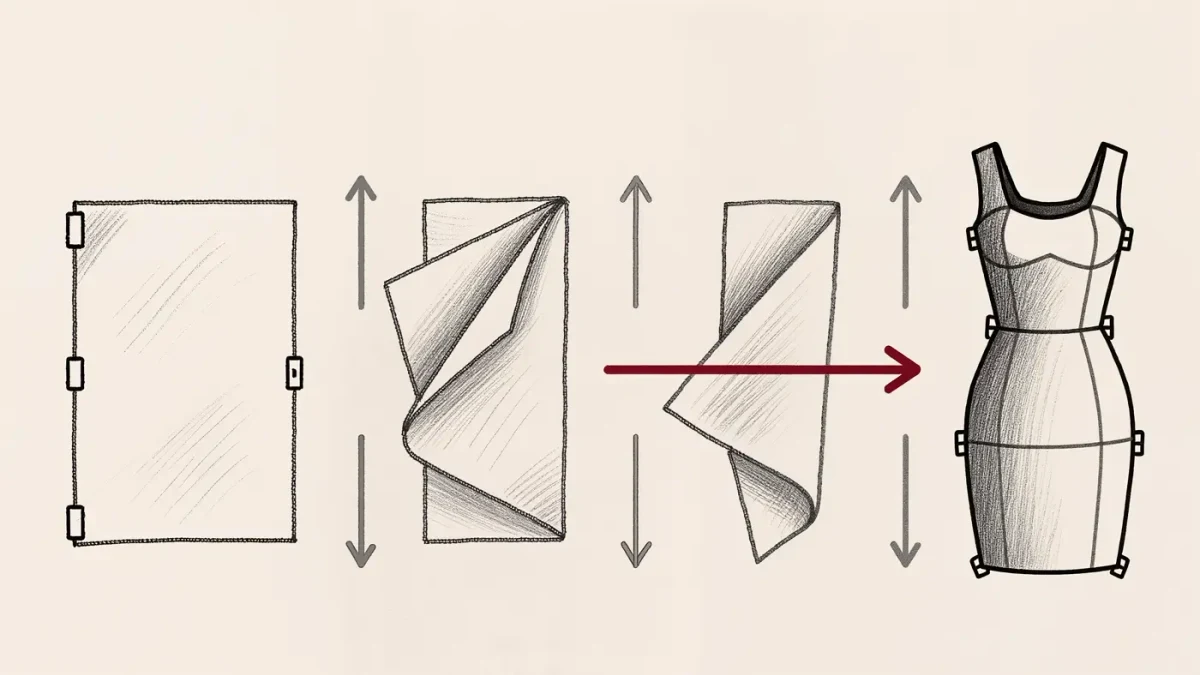
Functionally literal. The 2000 'Remote Control' finale transformed a chair's cover into a telescoping dress by remote control; the 2007 'Airborne' gown embedded over 15,000 Swarovski crystals and LEDs to display a video of blowing particles across the fabric, per the collaboration's documented record; later work integrated mechanical hems and shape-memory materials. The engineering is real — developed with technical partners over months — and its point is conceptual: clothing as the interface between the body and its environment, clothes that change as conditions change. Few designers have spent their career on that thesis; Chalayan's persistence is the signature.
What does the trade make of him?
The canonization is settled — museum retrospectives, notably the 2011 'Fashioning the Future' survey and the 2005 and 2009 Design Museum exhibitions, per the institutions' records, plus teaching and consulting roles across design disciplines — and the commercial record is the honest complication. Chalayan's own label has navigated scale limits typical of research-led houses, with collaborations and creative-director posts (notably the Puma years, 2008–2018, per the partner's announcements) funding the practice. The trade's verdict holds steady: the most conceptually rigorous designer of his generation, and proof that fashion's runway can carry ideas the weight of which most galleries would not attempt.