Issey Miyake, who studied graphic design in Tokyo before working in Paris and New York, founded his design studio in 1970 and spent the following four decades treating the garment as an engineering problem: how much of clothing can be made from a single piece of cloth, shaped by heat, mathematics or machine rather than by cutting the body out of fabric, per the studio's documented history. His Pleats Please line, launched in 1993, and A-POC — 'A Piece of Cloth', developed with engineer Dai Fujiwara and presented in 1998 — turned that question into products; the later 132 5. line, introduced in 2010 with researcher Jun Mitani's computational folding, pushed it into origami geometry. Miyake died in Tokyo in August 2022, and the studio continues the research practice he institutionalized.
Why do pleats matter to his story?
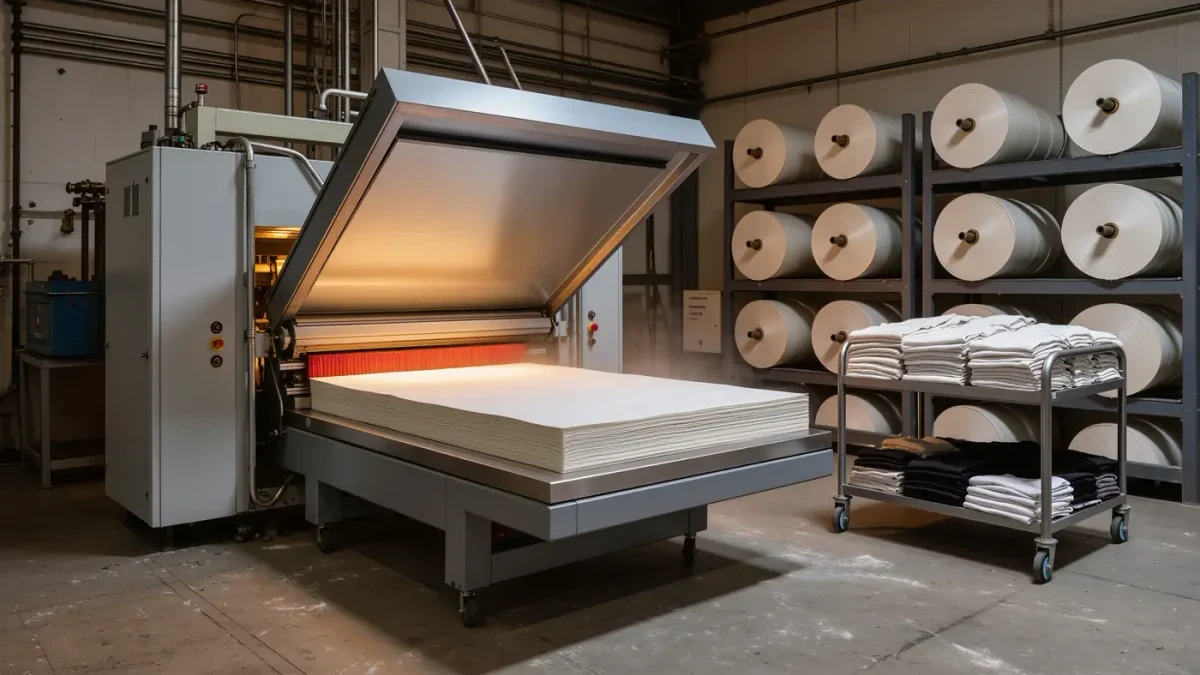
Because they inverted the direction of fashion's engineering. Pleats Please garments are cut oversized and then heat-pressed into permanent pleats — the shape is set into the fabric, not into the seam — producing clothes that fold flat, travel without creasing and flex with the body, per the studio's published descriptions. The line became a commercial pillar that funded further research, and it stated the studio's social position: engineering that serves mobility and everyday use, not spectacle. The pleats also gave performance worlds a uniform — most famously the choreographer William Forsythe's Frankfurt Ballet, which danced in them through the 1990s, per documented collaborations.
What was A-POC?
A machine-knitted tube. A Piece of Cloth produced garments from a single continuous fabric tube knit by computer-controlled machines, with no cutting waste in the classical sense — the customer or factory cuts the garment shape from the tube along pre-programmed lines. Shown in 1998 and refined with Fujiwara through the following decade, A-POC anticipated by years the industry's later turn toward zero-waste and computational pattern-making, and museum collections hold the tube garments as design objects in their own right.
Where does 132 5. fit?
As the research line, and the clearest art statement. Named for the dimensions it traverses — three dimensions of the folded object, two of the flat cloth, and the fifth as the space between — 132 5. applies mathematician Jun Mitani's folding algorithms to recycled PET fabric, producing garments that unfold from flat geometric shapes into sculptural dresses, per the studio's documentation. Exhibitions of Miyake's work, including major museum retrospectives during his lifetime and after, present the lines together as one continuous investigation.
Miyake's standing in design history rests on that continuity: he ran a fashion house as a research laboratory, published the results as products anyone could buy, and left a studio structure — separate lines for research, ready-to-wear and pleats — that keeps the experiment running after the founder. Few institutions in fashion can say the same.