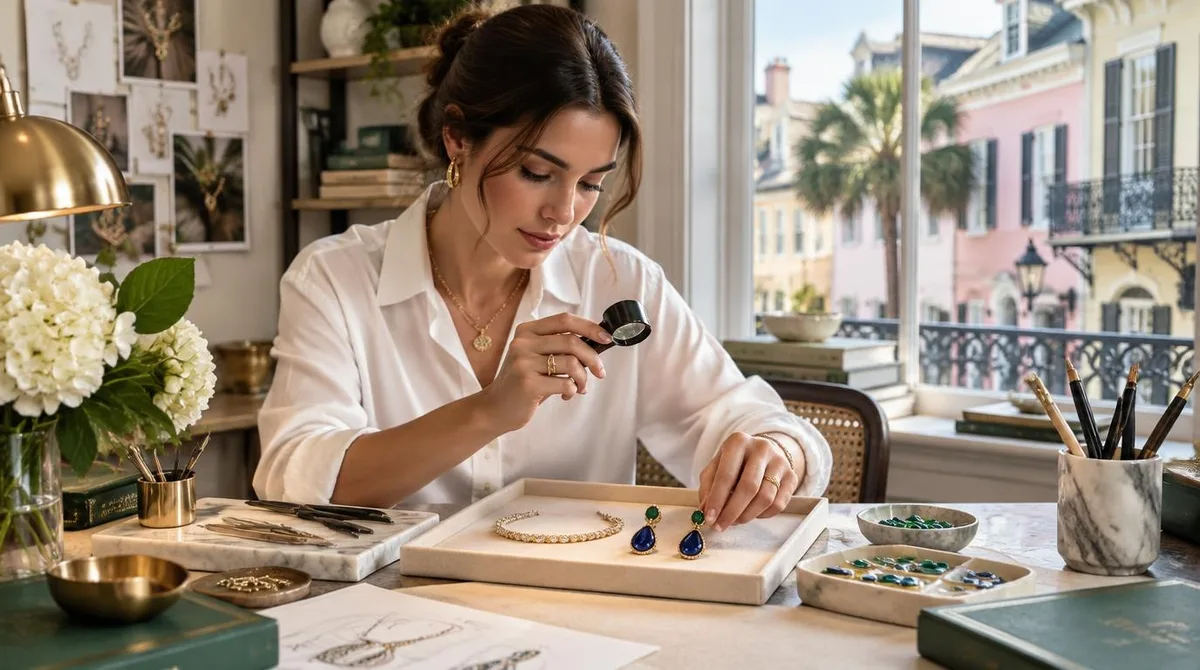
Hart Hagerty has run her eponymous jewelry line for a decade, and per Charleston Magazine, she only now feels she has earned the right to call herself a jewelry designer. That sentence, from a self-taught designer and seventh-generation Charlestonian, says more about how small jewelry businesses actually mature than any trend report. The line spans vibrant drop earrings, dainty tennis bracelets, and understated necklace cords, sold through a retail footprint that has grown well past its home city.
The scale is worth stating plainly. Beyond two local Charleston locations, Hagerty operates shops in Nashville, New York, Nantucket, and Dallas. She designs at a King Street studio and, when not opening storefronts, researches antique fonts at the library. The Charleston Magazine interview frames her as both artist and entrepreneur, and that double identity is the real subject here.
What does "design integrity" mean for a self-taught jewelry designer?
For Hagerty, it means the object holds together on its own terms. Design integrity is "paramount," she says, whether the piece is a drop earring, a tennis bracelet, or a plain necklace cord. The range itself is the argument: three categories that sit far apart on a jeweler's skill chart, from stone-set sparkle to a length of cord, treated with equal care.
Self-taught designers often arrive at the work through making rather than training, and the ten-year gap between launch and self-identification tracks with that. The title is earned by the body of work, not conferred at the start. In a trade where "designer" is printed on business cards from day one, the delay reads as a form of discipline.
Why does she describe jewelry as a tension between opposite values?
Because she says so directly, and the framing is more precise than it first appears. "Tension is inspiring," Hagerty told Charleston Magazine. Jewelry, in her account, is "a spiritual tool for self-expression, manifestation, and connection" — and also "just a shiny, pretty, hedonistic pleasure." She loves "that juxtaposition of opposite values."
That is a working philosophy, not a mood board. A piece that carries meaning for the wearer and still functions as decoration can be worn daily without ceremony. It explains the product logic of the line: charm-friendly, swap-able, wearable in more than one register. Fashion has a long record of borrowing seriousness from art and pleasure from commerce, a tension this desk has examined in how gallery framing changes a collection's meaning. Hagerty simply states the contradiction out loud and designs inside it. This connects to our earlier piece, Gallery Language Fashion — When Fashion Borrows Museum Language: How Gallery Framing Changes a Collection's Meaning. For related coverage, see Gallery Language Fashion — When Fashion Borrows Museum Language: How Gallery Framing Changes a Collection's Meaning.
What does the "Mixed Link Lariat" reveal about her method?
It shows a design built for repetition without sameness. Hagerty calls the new "Mixed Link Lariat" necklace "a real showstopper" and her new favorite chain, and compares it to her favorite vintage Levi's: something she can wear every day, "but never in the same way." She is "constantly swapping out charms" based on her vibe or style.
The vintage Levi's comparison is the tell. A garment earns long-life status by taking on new configurations over years, not by staying pristine. A chain designed as a base for changing charms is engineered for exactly that kind of longevity — the wardrobe logic of buy-once, restyle-forever, translated into jewelry. It is the opposite of a seasonal statement piece.
How does her personal style connect to the brand?
Her self-description — "warm, intuitive, considered — a polished minimalist, I am certainly not" — draws a clear line. She is not selling minimalism, and the line's warm, charm-driven, color-forward pieces match the description. The coherence matters: a designer whose personal style and product line point the same direction is easier to trust than one whose brand is a costume.
Her wish list confirms the eye. She hopes a Paco Rabanne "Iconic 1969" bag might appear, collects Murano glassware by Laguna B — "stupidly expensive but true works of art," in her words — and wants an Anya Hindmarch pouch because of a soft spot for googly eyes. That is a collector's taste: pieces with a point of view, gathered over time, not a rotation of trends.
Why does the ACBA campaign matter?
It puts institutional craft at the center of a brand story. Hagerty says she is "completely enamored" with the American College of the Building Arts, praising the talent, diligence, and independent thinking of its students. This summer, ACBA let her brand run a major campaign on its grounds, and she calls herself "quite smug" that they were "the first fashion brand to do a shoot there."
The claim is hers, as quoted, and it signals the strategic point regardless: a jewelry house aligning itself with a school of building arts is claiming kinship with craft training, not celebrity. For a self-taught designer, that is a coherent alliance. It also echoes a broader pattern in which fashion borrows the credibility of art institutions, from Margiela's method of refusing the spotlight to the way houses stage work in cultural spaces. For related coverage, see Fashion Show Art Installations: How Fashion Houses Commission Site-Specific Art Installations for Runway Shows. This connects to our earlier piece, Fashion Show Art Installations: How Fashion Houses Commission Site-Specific Art Installations for Runway Shows.
What should readers take from the Hagerty model?
Growth without speed, and identity before scale. Ten years in, with shops in four cities beyond her two local Charleston locations, a studio practice that includes library research on antique fonts, and a product line built around restyling rather than replacement. Her local gift list — LINNÉ "Balance" face oil, Candlefish candles, large tapers from Wentworth, books from Ladybird Books — reads the same way: small, specific, durable choices.
The evidence here is one interview, so the limits are real. What it establishes is a designer articulating her own method: tension as inspiration, integrity as standard, longevity as the test of a piece. Whether that model scales further is the open question. The first decade suggests she is in no hurry — and that the work has earned the title.